Last updated: November 2026
Source: Department of Veterans’ Affairs
The Department of Veterans’ Affairs will cover and consider funding the costs of alternative healthcare treatments for veterans that are experiencing specific physical health concerns.
Changes to the DVA treatment framework were introduced in February 2026, followed by the end of transitional arrangements on 31 August 2026. The changes affect who can prescribe DVA-funded treatment, how consultations work, and which treatments the DVA will fund.
How DVA Funding Works for Alternative Medicine
The Department of Veterans’ Affairs provides funding for alternative healthcare through the Repatriation Pharmaceutical Benefits Scheme (RPBS) and the latest criteria that fall within the DVA medicinal cannabis framework.
The DVA has been providing funding for these types of medicines since 2018. However, many veterans who had an existing prescription have been affected by the new framework that was rolled out in 2026.
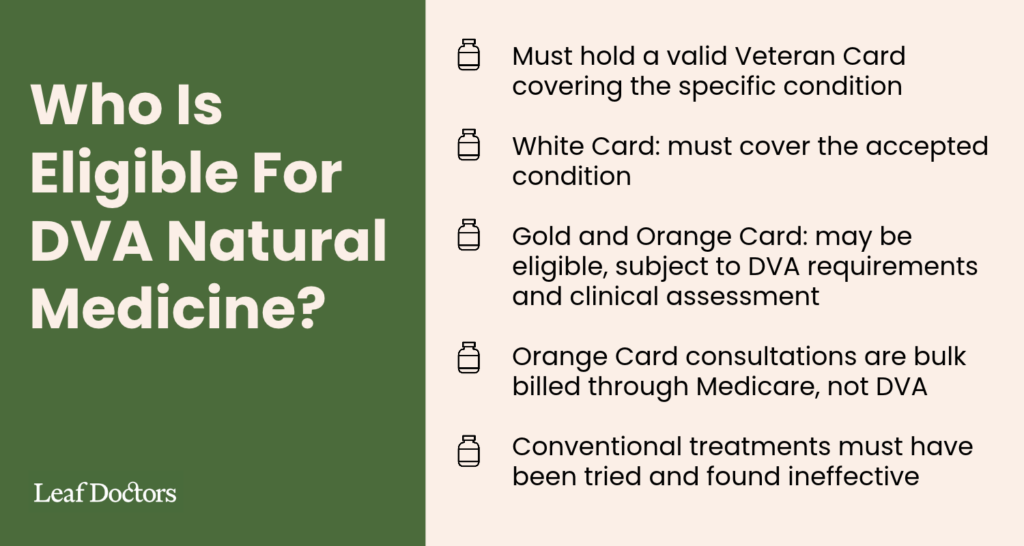
The veteran must hold a valid Veteran Card that covers treatment for their specific condition. That means if you are a White Card holder, your card needs to be specific to the accepted condition listed below. Gold Veteran Card and Orange Veteran Card holders may also be eligible, depending on the applicable DVA requirements and clinical assessment. Orange Veteran Card consultations are bulk billed through Medicare, not DVA. The DVA also requires veterans to have attempted evidence-based conventional treatments for the specific condition and for it to not have been effective.
The DVA is pretty explicit about not providing funding for conditions that are not explicitly listed. Even though the DVA will provide funded healthcare for a wide range of concerns, both mental health and physical health included, PTSD, anxiety, depression, and insomnia are not funded indications for alternative healthcare.
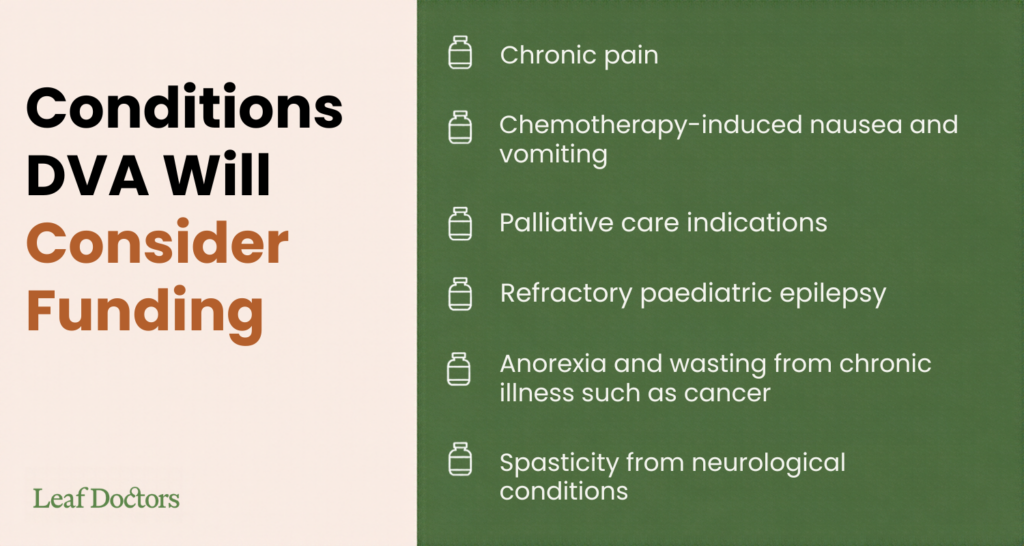
The DVA will consider funding treatments for a strict set of health concerns, including:
- chronic pain
- chemotherapy-induced nausea and vomiting
- palliative care indications
- anorexia and wasting associated with chronic illness such as cancer
- spasticity from neurological conditions
- refractory paediatric epilepsy
As an alternative healthcare provider, it’s important that we are transparent about the kind of support we can provide for veterans. We adhere to strict regulations set out by the TGA and the DVA to ensure that we’re providing fair, tailored treatment to all veterans, connecting patients with doctors who understand the unique needs of a veteran and how that may apply to alternative healthcare.
The New Medicinal Cannabis Framework
In early 2026, the Australian government announced changes to how the DVA may fund and support veterans and their healthcare needs, specifically for alternative healthcare and medicinal cannabis. The goal of these changes is to ensure the health and well-being of veterans, putting a focus on treatments approved under the DVA funding being both safe and effective. Over the last 8 years, funding of alternative medicine has generally been considered on a case-by-case basis for veterans living with chronic conditions. The framework does not change who is eligible for funded treatments. The updated framework is designed to provide guidelines for how veterans are treated, including ensuring that medical practitioners are appropriately registered, treatments are considered safe in line with doses and that veterans are getting in-person support for alternative healthcare. The updated DVA medicinal cannabis framework came into effect immediately for those who had not previously been prescribed. For those that have an existing prescription, there was a transitional period from February 2026 to August 2026.
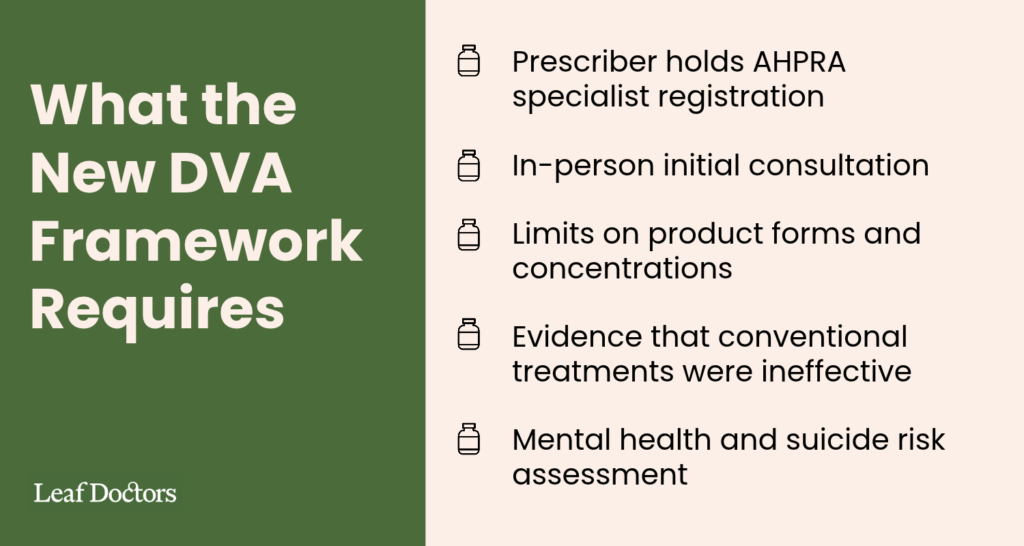
The new framework requires:
- Prescribers need to hold specialist registration with the Australian Health Practitioner Regulation Agency (AHPRA).
- The initial consultation and any consultations involving changes to the treatments are required to happen in person.
- There are regulations around the forms and concentration of treatments that should be prescribed with DVA funding.
- There needs to be evidence that your experience as a veteran has included standard conventional treatments for your condition that have been ineffective.
- There will also need to be a suicide and mental health assessment as part of the process.
What Changed in August 2026
The new framework was updated in February 2026, but it did not roll out for all participants from day one. Veterans who had an existing DVA-funded script were given a 6 month grandfathering period. This provided a chance for prescribers to be able to catch up with the new regulations without disrupting existing treatments.
The Grandfather transition concluded in August 2026. As of September 1 2026, every prescription needs to meet the new requirements of the DVA Medicinal Cannabis Framework.
For many veterans, this resulted in having to change providers, as their existing doctor no longer met the requirements, they needed to have an in-person consultation, or that their current treatment required a different approval process. If an existing prescription was outside the new product or dosage limits, it was up to the prescriber to review and adjust before the transition ended.
DVA Face to Face Consultation Requirements
One of the main requirements for the new framework is for veterans to have in-person consultations with prescribers and doctors for their initial consultation, and any following consultation appointments that explicitly change the treatment (for example, moving from tier 1 to tier 2 criteria).
For many alternative healthcare providers, they will not be able to provide veteran-specific support if they do not have in-person clinics for DVA cardholders to visit face-to-face. At DVA by Leaf Doctors, we have 2 clinics in Sydney and Brisbane, available for our patients to book an in-person consultation with an AHPRA specialist registered doctor. If you’re in Sydney, you can visit us at our clinic in Newtown, in the inner west. If you are in Queensland, we have a team available in Strathpine, in northern Brisbane.
An initial face-to-face appointment with the prescribing doctor is compulsory for first-time prescriptions, so for any veteran seeking a new DVA-funded prescription, as well as a patient who is changing prescribers. If you’re moving to DVA by Leaf Doctors or a new prescribing clinic, you need to have an in-person consultation. It’s also a requirement for any significant prescription changes to be discussed in person, particularly when it pertains to dosage, product changes, or escalating treatment levels.
Veterans who are currently receiving DVA-funded treatment from a specialist-registered doctor don’t need an in-person consultation for ongoing appointments. An in-person consultation is required again when changing prescriber or when a prescription change moves from Tier 1 to Tier 2. At DVA by Leaf Doctors, follow-up appointments are available by telehealth where clinically appropriate.
An in-person consultation is really important for healthcare professionals to be able to assess DVA patients and determine suitable care, in line with the DVA requirements. The DVA will only fund treatment for new patients if the initial consultation is conducted face to face.
DVA Product Format and Dosage Limits
The 2026 changes to DVA-funded alternative healthcare also pertain to product formats and dosages. At DVA by Leaf Doctors, we adhere to strict regulations set by the Australian Therapeutic Goods Administration. As such, we’re unable to disclose specific treatment names or products explicitly on our website. This article is aimed at purely providing information around the DVA requirements as per the Department of Veterans’ Affairs.
The changes that came through in early 2026 have set dose limits on specific products. To cite the DVA specifically:
- The program will fund only products with CBD and/or THC as the only labelled active ingredients. Products with other actives are not funded.
- Oral forms are limited to capsules and liquid preparations.
- Dried herb for vaporisation through a TGA-approved medical device.
- Dried herb at a THC concentration of 25% or less.
- Total dried herb for vaporisation of 2 grams per day or less across all product formats.
- A maximum of 3 products can be prescribed at any one time.
DVA Tier 1 and Tier 2 Criteria
There are also two criteria that applications will be sorted into, which place restrictions on the number of products and total daily THC dosage.
| Tier 1 | Tier 2 | |
| Number of products | Maximum 2 at any one time | Up to 3 at any one time |
| Total daily THC | 40mg or less per day | More than 40mg per day |
If any of the criteria falls into Tier 2, the whole request becomes a Tier 2 application. For Tier 1 applications, the treating clinic or practitioner will need to apply for approval with the RPBS authority prescription by getting in touch with the Veterans’ Affairs Pharmaceutical Advisory Centre while with the patient. Tier 2 applications need to be in writing and be accompanied by a written assessment from a relevant treating non-GP specialist whose specialty is directly relevant to the condition being treated. The Tier 2 application needs to be explicitly relevant to the conditions being treated, the doctor’s active support for the treatment, and the previous attempts at treatment that have led to the Tier 2 recommendation.
DVA Prescriber Requirements
As a prescriber, it’s important that clinics and practitioners adhere to the strict regulations set out by the DVA. This includes:
- The doctor must have a specialist registration with AHPRA.
- The assessment is to have followed AHPRA’s guidance on prescribing.
- Alternative medicine that is being prescribed is clinically indicated and may benefit the client, or if this is for a repeat prescription, it needs to have shown clinical benefit to the patient.
- As mentioned, this process needs to have involved an in-person consultation for a first prescription, when changing prescriber, or for any change that moves a patient from Tier 1 to Tier 2.
- All state, territory, and Commonwealth approvals have been obtained, including TGA authorisation.
- A mental health assessment has been completed in relation to the treatment, and there is no increased risk to suicidal ideation or mental health concerns.
- The client also needs to have no current substance use disorder and be a low-risk patient for these concerns.
How DVA by Leaf Doctors Can Help
DVA by Leaf Doctors offers in-person consultations with specialist-registered doctors at our clinics in Newtown NSW and Strathpine QLD, both located inside True Green Health. Follow-up appointments are available by telehealth where appropriate.
Consultations are bulk billed for eligible DVA Veteran Card holders. Our care coordinator and nursing team provide dedicated support with DVA approvals and eligible claims, including travel, medical devices and medication.
Whether your existing treatment has been disrupted or you’re exploring your options for the first time, our team can review your situation and explain the next steps. No GP referral is required. Book a call with our care team to get started.